
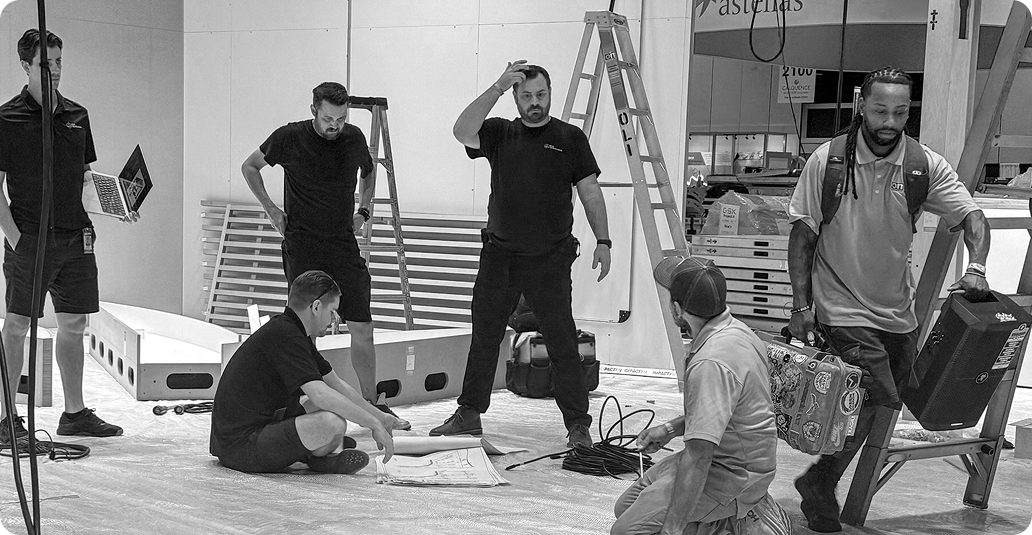
Every great event starts with a strong idea.
A bold creative direction. A compelling narrative. A vision for how people should feel the moment they enter the space. And then, somewhere between concept approval and show open, things start to unravel.
Not because the idea wasn’t good, but because execution entered the conversation too late.
Execution isn’t the last step of the process. It’s part of the creative act.
Where It Usually Breaks
We see this across the industry, especially with agencies and exhibit houses operating under compressed timelines.
AV Is Brought in After the Vision Is Locked
By the time execution partners are involved, the creative has already been approved. Sightlines, power, rigging, weight loads, content formats – the realities that determine whether an idea works, haven’t been pressure-tested yet.
The result? Compromises that dilute the original intent.
Budgets Are Set Before Technical Reality Is Understood
Creative ambition often moves faster than feasibility. When execution enters late, teams are forced to reverse-engineer bold ideas into constrained realities usually under pressure.
Venue and In-House AV Constraints Surface Too Late
Rigging points, ceiling heights, union rules, power availability – none of these are blockers on their own. But discovered late, they become costly, stressful surprises.
“AV Will Figure It Out” Becomes the Plan
Execution teams are exceptional problem-solvers. But being asked to save an experience instead of shaping it rarely produces the best outcome.
Why This Keeps Happening
This breakdown isn’t about talent or intent. It’s structural.
- Speed is rewarded
- Silos still exist
- Execution is treated as a downstream function
The goal is never to cut corners, but without early collaboration, even the strongest ideas suffer.
How Peak Approaches This Differently
At Peak, we believe execution isn’t the last step of the process, it’s part of the creative act itself.
Early Technical Translation
We engage early to translate creative vision into executable systems, not to limit ideas, but to protect them.
Designing with constraints early protects creative vision later.
Designing With Constraints, Not Around Them
Every venue, budget, and timeline has constraints. When acknowledged early, they become design inputs instead of last-minute obstacles.
Execution as Experience
Audio, lighting, video, and systems integration aren’t background elements, they are the experience. When execution is aligned early, the result feels intentional and confident.
Fewer Surprises, Better Outcomes
Earlier collaboration leads to:
- Fewer compromises
- Cleaner installs
- Smoother show days
- Stronger audience impact
THE BOTTOM LINE
When execution partners are brought in too late, creative vision erodes.
When they’re involved early, ideas don’t just survive, they scale.
That’s how Peak approaches every project: not as a vendor at the end of the line, but as a partner committed to making ideas work in the real world.