
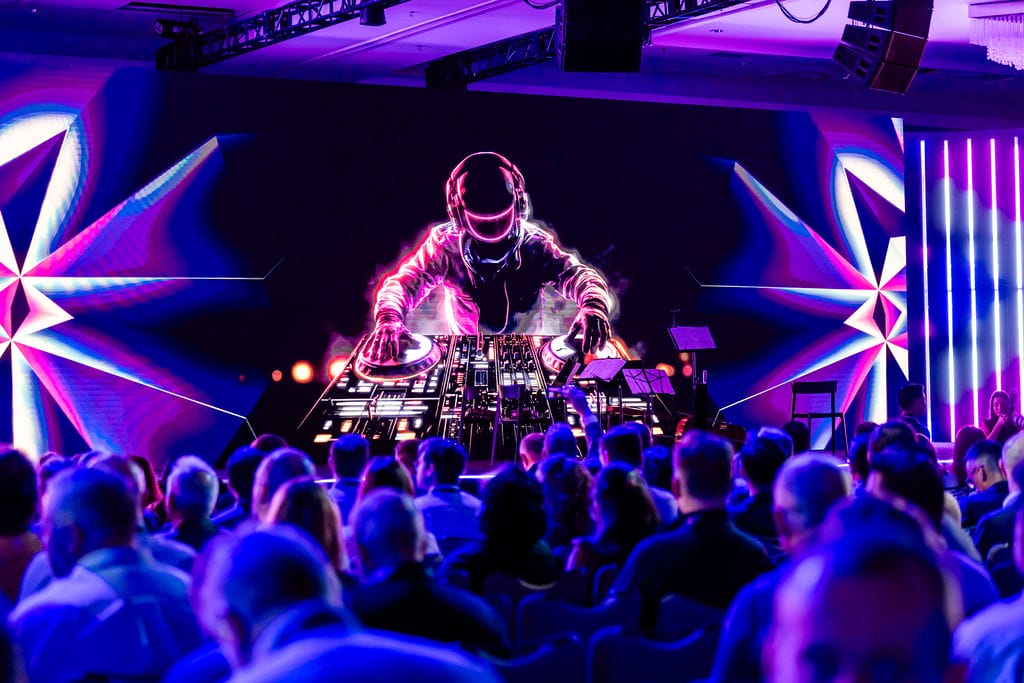
A general session is where an event makes its case. The audience is together in one room for the announcements, the keynote and the moments the whole program is built around. From a seat in that room, it should be obvious who is speaking, what is on screen and where to look next.
That clarity is not produced on show day. It is the result of production planning, technical coordination, rehearsal and clear ownership established weeks before the audience walks in. By the time the doors open, the decisions that matter have already been made or quietly skipped.
The useful way to think about a general session is not as a list of equipment. It is a sequence of connected decisions, each with someone accountable for it. That doesn’t mean one person or company owns every decision. On larger programs, responsibilities may be shared across the client, agency, Executive Producer, production partners, venue and other specialists. What matters is that those responsibilities are clearly defined and connected. Here is how that sequence runs, and the question worth asking at every stage: who owns what?
Start with the objective, not the room
Before anything is specified, describe what the session has to achieve. Is it an executive address, a product announcement, a panel, a customer story, or several of these in sequence? What should the audience understand or feel when each segment ends?
That answer shapes everything downstream. A session built to land one strategic message is produced differently from one built to demonstrate a product in detail.
Who owns this: Typically led by the event owner and/or agency production team, depending on how the program is structured.
Understand the room before the design
Audience size, seating arrangement, sightlines, ceiling height, rigging capacity, ambient light and power all shape what is possible before any creative work begins. A room that cannot support an idea will not be persuaded to by a rendering.
Ask how people at the back and the sides will see the presentation and hear each speaker. Ask what changes when a panel replaces a single presenter, or when a demonstration needs detail visible from fifty feet.
Who owns this: Typically coordinated across the production partner, agency production team and venue, with responsibilities defined according to the scope of the program.
Build the show flow with owners attached
A show flow describes the order of the program. It becomes genuinely useful when it also records who can approve each part of it.
Four questions settle most of this:
- Speaker and presentation approval. Who confirms the approved speakers, slides and video?
- Timing and transitions. Who approves the running order and any change to segment lengths?
- Technical decisions. Who reviews how the room, content and production systems fit together?
- Changes during the event. Who receives a request, checks its implications and authorizes it?
Record the agreed contacts alongside the current show flow, so nobody spends show day asking who can make a call.
If you are still selecting a production partner, these are the same accountability questions worth asking during that process. Our event AV buyer’s guide covers that conversation in more detail.
Let the technical design follow the first three
Technical design is where the objective, the room and the show flow become a system: screens, audio, lighting, staging, signal paths and the way they connect. Done in the right order, it answers questions that were already asked. Done first, it produces a specification that the program then has to accommodate.
This is the stage where equipment decisions belong, and where they make sense, because by now there is something for them to serve.
Who owns this: Typically led by the production partner in coordination with the agency production team, event owner and venue as required.
Treat content as a deadline, not a delivery
Content keeps moving after most other decisions have settled. That is normal, and it is why the handoff needs to be defined rather than assumed.
Agree what the production team needs, in what formats, and when it needs to review it. Name one owner for the current approved versions. A slide replacement or a recut video the morning of the session should have a defined handoff, so everyone knows which version is the one going into the room.
Who owns this: Ideally, one clearly identified content owner on the client or agency side. Leaving it unassigned is what turns a routine slide swap into a question nobody can answer with the room filling up.
Rehearse the transitions, not just the content
Rehearsal is not a sound check. It is the last point at which a problem can be found while there is still time to solve it.
Walk the transitions specifically. How does a presenter hand off to a video? What happens when a panel follows a keynote? Where should the audience be looking during a demonstration? Presenters who have never worked with the room, unfamiliar content and complex transitions are where rehearsal time earns its place.
Agree in advance what can be checked during preparation and what has to be seen in the actual room, and set rehearsal priorities against the specific demands of the program rather than a generic schedule.
Who owns this: Shared across the production team, agency and event owner, with responsibilities defined by the structure of the program and enough time protected in the schedule for rehearsal to happen properly.
Decide the contingencies before you need them
Ask which contingencies need planning, what response is realistic within the scope and schedule, and who decides if a segment has to change mid session.
The point is not to plan for everything. It is to know, in advance, who makes the call and what the options are, so a decision during the session is a choice rather than an improvisation.
Who owns this: Agreed across the event owner, agency and production team, with decision-making responsibilities clearly established before show day.
Show execution is where the planning comes together
By the time the audience is seated, much of the work that determines whether the session will succeed has already happened. What follows is the live execution of weeks of planning, coordination and preparation. The sessions that feel effortless are the ones where the objective was clear, the room was understood, the show flow had owners, the content arrived on time and the transitions had been rehearsed.
How this looks in a real program
At SailPoint Navigate 2025 in Orlando, we worked with Impact XM (now Jack Morton) across a program that ran general sessions alongside breakout content. Our scope covered general session AV production, audio, video and lighting for the breakout rooms, presentation and playback support, and on site technical direction and engineering.
Supporting the general session and breakout environments within a coordinated technical production scope helped create consistency across the program, while allowing Peak to work closely with the agency production team on the technical requirements of each environment.
What to bring to the first conversation
Your objective, the room format, the key moments and your current content requirements. Before planning goes further, settle three things: who approves the show flow, when final content will be reviewed, and who owns a change on show day.
Those answers make the remaining decisions visible while there is still time to make them well.