
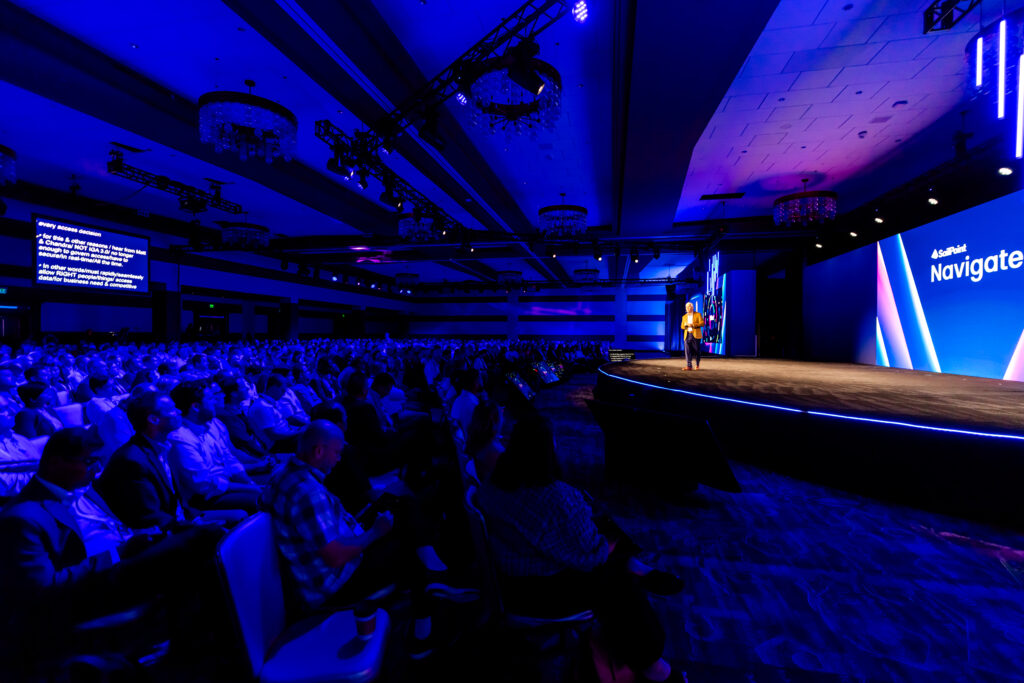
Choosing an event AV production company is ultimately a decision about execution. The equipment matters, but the greater value lies in the people and planning behind it: who anticipates problems, coordinates the moving pieces and makes sure the technology supports the purpose of the event.
For a marketing director, event manager, exhibit partner or agency lead, the right production partner should do more than fill an equipment list. They should help reduce risk, improve the experience and carry responsibility from early planning through show day.
This guide outlines what a full-service event AV production company does, how to evaluate potential partners and which questions can reveal whether a provider is equipped for the complexity of your program.
What does an event AV production company do?
An event AV production company plans, engineers and operates the technical elements of a live experience. Depending on the program, that can include audio, video, LED, lighting, staging, show control, interactive technology, content playback, live show calling and the project management that connects everything.
The equipment is only one part of what the client is buying. The real value is in coordination and live decision-making: the judgment that keeps a program moving when a presenter runs long, a file changes at the last minute, a feed drops or another vendor’s delay affects the production schedule.
A rental company provides equipment. Full-service production provides a team that helps design the environment, develops the technical plan, coordinates with the venue and other partners, operates the event and responds when conditions change.
The strongest providers do not treat audio, video, lighting, staging and experiential technology as separate orders. They engineer them as one connected system built around the audience, the environment and the event’s objectives.
How do you evaluate an AV production company?
Price and equipment lists are easy to compare. They are also incomplete indicators of how a company will perform under pressure. A more useful evaluation looks at how the provider approaches ownership, risk, communication and integration.
Consider the following areas when building a shortlist:
- Accountability: Who owns the production plan, schedule and outcome? Is that person involved throughout the process and present or directly accessible during the event?
- Contingency planning: What happens if a display, signal path, network connection or playback system fails? A credible provider should be able to explain its backup strategy specifically, not simply promise that everything will work.
- Access to expertise: Can your team speak directly with the technical and production leaders making the critical decisions, or will information pass through several layers?
- Relevant experience: Has the provider delivered events with similar complexity, environments and operational constraints, not merely worked with recognizable brands?
- Integration: How will the provider coordinate with your agency, exhibit builder, venue, general contractor, content team and other event partners?
- Scalability: Does the company have the people, owned inventory, engineering depth and operating network required to support the size and geography of your program?
- Business understanding: Does the team ask what the event needs to accomplish, or does the conversation begin and end with equipment?
One of the most revealing questions is also one of the simplest: Walk us through what happens if a critical system fails during the event. The specificity of the answer will tell you a great deal about the provider’s preparation and experience.
Why early technical collaboration matters
Technology delivers more value when production expertise enters the process early. Once the room layout, design, content format and audience journey are locked, many of the best technical options may become more expensive or no longer possible.
Early collaboration allows the production team to assess sightlines, rigging, power, acoustics, structural requirements, content specifications, show flow and audience interaction while there is still time to improve the plan. It can also uncover more effective ways to use the budget. A different LED configuration, room orientation or content approach may create greater impact without simply adding more equipment.
For experiential programs, product launches and custom environments, the creative idea and technical solution should be developed together. A concept is only successful if it can be engineered, transported, installed, operated reliably and repeated where required.
The earlier those considerations are addressed, the more problems can be solved during planning rather than on site, where changes are more disruptive and expensive. Just as importantly, it gives clients peace of mind: confidence that the right questions have been asked, the risks have been anticipated and an experienced team is prepared to carry the production through show day.
Large venue-aligned providers vs. independent production partners
There is no universally right provider model. Large venue-aligned companies can offer extensive venue relationships and standardized services across a broad footprint. Independent production partners can often provide greater flexibility, more direct access to senior expertise and a more tailored approach.
The right choice depends on the complexity of the event and the level of integration, customization and accountability it requires.
| Consideration | Large venue-aligned provider | Independent production partner |
|---|---|---|
| Venue access and relationships | Often deeply established within contracted venues | Coordinates with venues and local requirements across markets |
| Production approach | Frequently standardized to support a high volume of concurrent events | More often tailored around the program, environment and creative requirements |
| Resource availability and continuity | Teams and senior resources may be shared across multiple events, particularly during busy periods | Core personnel can often remain more consistently involved from planning through execution |
| Specialized technical depth | On-site teams may be structured as broad generalists, with advanced specialists supporting multiple accounts or brought in as required | Specialized technical expertise can be assembled directly around the needs of the program |
| Access to senior technical leadership | Depends on the account, event size and availability within the operating model | Often more direct throughout planning and execution |
| Custom engineering and integration | Available, but may fall outside standard venue packages or require additional resources | Can be central to the production approach |
| Cross-vendor collaboration | Varies by team and scope | Often structured around close collaboration with agencies, exhibit houses and specialist partners |
| Multi-city support | Broad venue infrastructure and standardized processes | Available through qualified teams, owned resources and vetted production networks |
Buyers should evaluate the actual team, plan and capabilities rather than selecting by category alone. Ask who will lead the work, which resources are owned or directly controlled and how quality and accountability will be maintained in every market.
What to look for in a trade show AV partner
Trade show production involves a distinct set of pressures: fixed move-in windows, union and venue rules, freight schedules, rigging and power approvals, limited storage, neighboring exhibits and multiple vendors working in the same footprint.
A capable trade show AV partner should be coordinating with the exhibit builder, agency, general contractor, show management and venue well before installation begins. If those conversations start on the show floor, the project is already carrying unnecessary risk.
The technology should also feel integrated into the exhibit rather than added after the design is complete. LED dimensions, viewing distance, lighting, audio coverage, interactive elements, structure, cable paths and content requirements all affect the physical environment.
Ask a prospective partner to walk through its plan for:
- Advance coordination and technical drawings
- Union labor and venue requirements
- Freight, installation and dismantle schedules
- Power, rigging and structural approvals
- Content testing and playback
- On-site technical support during show hours
- Backup equipment and rapid-response procedures
Strong trade show partners make installation and show operation appear straightforward because the difficult decisions were addressed weeks earlier.
Evaluating experiential technology and custom LED capabilities
Experiential activations, product launches and custom LED environments require more than equipment availability. They depend on creative and technical systems working as one designed experience.
For large-format or non-standard LED, ask whether the provider can engineer the complete solution rather than simply supply panels. That includes processing, signal distribution, power, structure, redundancy, content specifications, viewing distance and service access. Curved displays, corners, unusual aspect ratios and integrated scenic elements introduce additional considerations that should be resolved before fabrication or content production begins.
For interactive and experiential programs, determine whether the provider can integrate technologies such as sensors, touch interfaces, RFID, real-time content, show control and data capture into the larger production environment. Just as importantly, ask how the experience will be tested, supported during the event and designed to recover gracefully if a component is interrupted.
Useful questions include:
- Can the solution be engineered around the creative concept and physical environment?
- How will the technology integrate with scenic, structural and content partners?
- What testing will occur before the event and again on site?
- How will the system be monitored and supported during operation?
- Can the experience be transported, repeated or adapted for future markets?
- How will engagement or other program outcomes be measured where appropriate?
Demonstrated experience matters more than a general capability list. Ask the provider to explain a comparable technical challenge, the risks it identified and how the final solution was delivered.
How far in advance should you hire an AV production company?
As a working guide, engage an event AV production company approximately 8 to 12 weeks before a standard event. Larger, custom or multi-city programs generally require more planning time, particularly when they involve content development, custom fabrication, interactive technology, complex LED engineering or extensive venue approvals.
Compressed timelines can often be accommodated depending on scope, inventory and crew availability. However, earlier engagement creates more opportunity to improve the design, manage costs and reduce on-site risk.
Can an independent AV production company support multi-city or North American events?
Yes. The more important question is not whether a company is labelled national or independent, but how its coverage is delivered.
Some independent production partners support programs across North America through a combination of experienced internal teams, owned inventory, established facilities and vetted production resources in additional markets. For a multi-city program, ask:
- Who retains overall accountability across every location?
- Which people and equipment are supplied directly?
- How are local partners selected and managed?
- How are technical standards, documentation and show files maintained?
- What changes and what remains consistent from city to city?
A credible answer should describe the operating process, people and quality controls, not simply point to locations on a map.
When is a specialized AV production partner the right fit?
A specialized AV production partner is often the strongest fit when an event requires more than a standardized AV package. Examples include:
- Complex trade show exhibits requiring close integration with the booth design and installation plan
- Product launches where content, timing and technical reliability must work precisely together
- Corporate events that combine general session production with custom scenic, LED or broadcast requirements
- Brand activations involving interactive technology, data capture or a designed audience journey
- Custom LED environments requiring engineering beyond a conventional rectangular display
- Multi-city programs that need consistent production standards with centralized accountability
In these situations, buyers benefit from a partner that combines technical depth, direct access to experienced production leadership and the ability to collaborate across creative and operational teams.
Peak Technologies provides integrated event production, advanced LED and experiential technology for trade shows, corporate events, brand activations and permanent environments. With facilities in Las Vegas and Oakville, Ontario, owned technology inventory and experienced production teams, Peak supports programs across North America while working alongside brands, agencies, exhibit houses and venue partners.
Making the decision
The right event AV production company is not necessarily the provider with the longest equipment list or the largest footprint. It is the team whose technical judgment, production approach and level of accountability fit the event and whose involvement reduces the amount of execution risk carried by the client.
Before committing a budget, pressure-test each provider’s plan. Ask who will lead the work, how the systems will be integrated, what has been learned from comparable programs and how the team will respond when conditions change.
Planning a trade show, corporate event or brand experience? Tell us what you are building, and the Peak team can help you evaluate the right production approach.
Frequently asked questions
What does an event AV production company do?
An event AV production company plans, engineers and operates the technical elements of a live event. Services can include audio, video and LED, lighting, staging, show control, interactive technology, live show calling and the project management that coordinates the complete production.
How do I evaluate an AV production company?
Evaluate its accountability, contingency planning, access to senior expertise, relevant experience, integration with other vendors and ability to scale. Ask for specific explanations of how the company plans a comparable event and responds when a critical system fails.
What is the difference between a venue-aligned provider and an independent production partner?
Large venue-aligned providers often offer extensive venue relationships and standardized services across a broad footprint. Independent production partners can often provide greater customization and more direct access to senior technical expertise. The right fit depends on the event’s complexity, environment and production requirements.
How far in advance should I hire an AV production company?
Approximately 8 to 12 weeks before a standard event is a useful working guide. Larger, custom and multi-city programs generally need more time. Compressed timelines may be possible depending on scope, equipment and crew availability.
What questions should I ask before hiring an AV production company?
Ask who owns the production timeline and outcome, who will be on site, how systems and vendors will be coordinated, what contingency plans are in place, which resources are owned or controlled and how quality will be maintained across locations.
Can an independent AV company support multi-city or North American events?
Yes. Qualified independent partners can support multi-city and North American programs through internal teams, owned inventory, established facilities and vetted production networks. Ask how accountability, technical standards and quality control are maintained in each market.